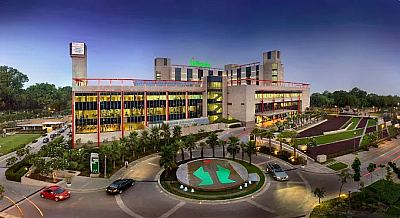

Fortis Memorial Research Institute stands as a world-class, multi-super-specialty hospital, offering advanced quaternary care. It brings together globally recognized doctors, highly skilled specialists, and expert nursing teams, all empowered by state-of-the-art technology. Widely regarded as one of the leading hospitals in Gurugram, it serves as a trusted referral hub for patients across the Asia-Pacific region and beyond. Spread across a vast 11-acre campus, this "next-generation hospital" has been built on the foundation of trust and excellence. Its strength lies in four core pillars—exceptional medical talent, cutting-edge technology, compassionate service, and world-class infrastructure.
About Business
Fortis Healthcare Limited is one of India’s leading and most trusted healthcare providers, offering an integrated range of services across hospitals, diagnostics, and day-care specialties. With a strong presence in 11 states, Fortis operates 33 healthcare facilities (including joint ventures and managed hospitals), supported by a network of 400 diagnostic centers. Together, these facilities provide more than 5,700 operational beds and are backed by the dedication of over 12,500 healthcare professionals.
Recognized for its commitment to excellence, Fortis has earned 4 JCI accreditations and 26 NABH accreditations, making it a benchmark for quality healthcare in India.
Our Vision
To build a world-class, integrated healthcare system in India—where advanced medical expertise meets compassionate care.
Our Mission
To be a globally respected healthcare organization, known for clinical excellence and distinctive patient care.
Our Values
Patient Centricity
We place patients at the heart of everything we do—delivering the best outcomes, showing compassion, and ensuring their needs always come first.
Integrity
We act with honesty, transparency, and moral courage, always choosing to do what is right.
Teamwork
We believe in collaboration, respecting diverse perspectives, and working as one team to achieve our goals.
Ownership
We take responsibility for our actions, honor our commitments, and go beyond expectations to make a difference.
Innovation
We continuously challenge ourselves to improve, embrace new ideas, and adopt a ‘can-do’ approach to exceed patient expectations.
With one mission, one vision, and one commitment, Fortis Healthcare continues to redefine healthcare standards and bring world-class medical services closer to communities across India.
Services / Products
Radiation therapy for breast cancer
₹3,000.00
Overview Radiation therapy (RT) is an important treatment option for breast cancer. It uses high-energy beams, such as X-rays or protons, to destroy cancer cells. These rays are invisible and painless as they pass through the body. RT may be given on its own or combined with surgery and/or chemotherapy. The treatment works by damaging the DNA of cancer cells, making it hard for them to grow and multiply, while protecting the surrounding healthy breast tissue. Types of Radiation Therapy for Breast Cancer Radiation therapy can be delivered in different ways, depending on the stage and type of breast cancer: External Beam Radiation Therapy (EBRT): High-energy beams are delivered from outside the body using a machine called a linear accelerator. Modern methods such as intensity-modulated RT (IMRT) or stereotactic RT ensure precise targeting. Internal Radiation Therapy (Brachytherapy): Small radioactive seeds or devices are placed directly inside the breast tissue to deliver radiation to the target area. Intraoperative Radiation Therapy (IORT): Radiation is given immediately after surgery to the area where the tumor was removed, targeting any remaining cancer cells. When Is Radiation Therapy Recommended? Radiation therapy may be advised in the following situations: To destroy remaining cancer cells after surgery (lumpectomy or mastectomy). To relieve symptoms of advanced breast cancer. In combination with chemotherapy for better outcomes. For cancers that cannot be removed surgically. For aggressive cancers, such as inflammatory breast cancer (alongside chemotherapy and surgery). To treat cancers that have spread (metastatic breast cancer) and help shrink tumors to ease pain. Before Treatment Before starting RT, your healthcare team will: Review your medical history and conduct a physical exam. Plan your treatment through a process called radiation simulation, where they determine the safest and most comfortable position for you. Mark the treatment area with temporary or permanent markers. Use advanced imaging tests like CT or MRI to map the tumor’s size, shape, and location. Sometimes, custom masks or shields are made to protect nearby healthy organs. Radiation therapy is usually scheduled 3–8 weeks after surgery or 3–4 weeks after chemotherapy. Most sessions are done on an outpatient basis. During the Procedure RT is usually given 5 days a week for 5–6 weeks, with each session lasting 10–30 minutes. You will lie on a treatment table in the same position determined during planning. Imaging tools such as X-rays, CT scans, or lasers ensure accurate targeting each time. For EBRT, a machine directs the radiation beams precisely at the tumor site. For brachytherapy, radioactive seeds or tubes deliver high doses of radiation directly inside the breast tissue. RT can be given after: Lumpectomy (Breast-Conserving Surgery): Radiation is used to treat either the entire breast (whole breast irradiation) or only the affected part (partial breast irradiation). Mastectomy: RT may be recommended if cancer has spread to lymph nodes or if there is a higher risk of recurrence. After the Procedure The radiation itself takes only a few minutes, but preparation may take 30–45 minutes. Regular CT or MRI scans are done afterward to monitor how well the treatment is working. Most patients can resume daily activities soon after their session. Possible Side Effects Side effects vary based on the area treated and the type of radiation given. Common ones include: Fatigue Skin irritation (redness, peeling, or blistering) Swelling in the breast or arm Rib fractures (rare) Secondary cancers (very rare) Most side effects are temporary and manageable with medical support. Conclusion Radiation therapy plays a vital role in the treatment of breast cancer. Whether used alongside surgery, chemotherapy, or as a stand-alone treatment, it helps destroy cancer cells, lowers the risk of recurrence, and improves long-term survival.
Contact Information
- Owner / Founder: Fortis
- Contact Person: Health Care
- Phone: 08860022554
- WhatsApp: +91 8860022554
- Email: feedback@fortishealthcare.com
- Website: https://www.fortishealthcare.com/
Location Map
Reviews
No reviews yet.