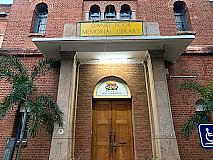
Daniel Poor Memorial Library, Madurai, Tamil Nadu

The story of the Daniel Poor Memorial Library is not just about a building filled with books it is a story of vision, generosity, education, and a deep commitment to preserving knowledge for generations to come. What stands today as a center of learning began nearly a century ago as a heartfelt tribute to a man whose life was dedicated to education and missionary service.
About Daniel Poor Memorial Library, Madurai, Tamil Nadu
The foundation of this remarkable institution can be traced back to the generosity of Mrs. Samuel A. Morman, the granddaughter of Dr. Daniel Poor. Motivated by respect for her grandfather’s legacy and a desire to contribute meaningfully to education, she made a substantial donation of $25,000 to the American Board. At that time, this was a significant amount, reflecting not only her financial commitment but also her belief in the power of knowledge and learning. Her contribution laid the groundwork for what would become an enduring academic and cultural resource.
The formal beginning of the library building took shape on January 26, 1926, when the cornerstone was laid. This moment marked more than just the start of construction it symbolized the continuation of Dr. Daniel Poor’s mission in a new form. Dr. Poor himself was a pioneering figure. As one of the early missionaries of the American Board, he played a crucial role in establishing the American Ceylon Mission in Jaffna in 1816. His efforts were instrumental in spreading education and fostering intellectual growth in the region. Later, in 1835, he also became one of the founders of the American Madura Mission, further expanding his influence and dedication to educational development.
The library was envisioned as a modern and functional academic space for its time. The original architectural plan was thoughtfully designed to meet both present and future needs. The ground floor was intended to house a stack room capable of accommodating approximately 50,000 volumes a substantial collection by early 20th century standards. In addition to this, the ground floor was to include a small museum, which would serve as a cultural and educational exhibit area, as well as a teacher’s room, providing a dedicated space for faculty members.
The first floor was equally purposeful in its design. It was planned to include a spacious library study room, offering students a quiet and focused environment for reading and research. Alongside this, two lecture rooms were incorporated into the plan, emphasizing the building’s role not just as a repository of books but as a dynamic space for teaching, discussion, and academic exchange.
Services
Contact Information
Location Map
📍 Open in Google Maps / Get DirectionsFrequently Asked Questions
Reviews
Similar Businesses Nearby